
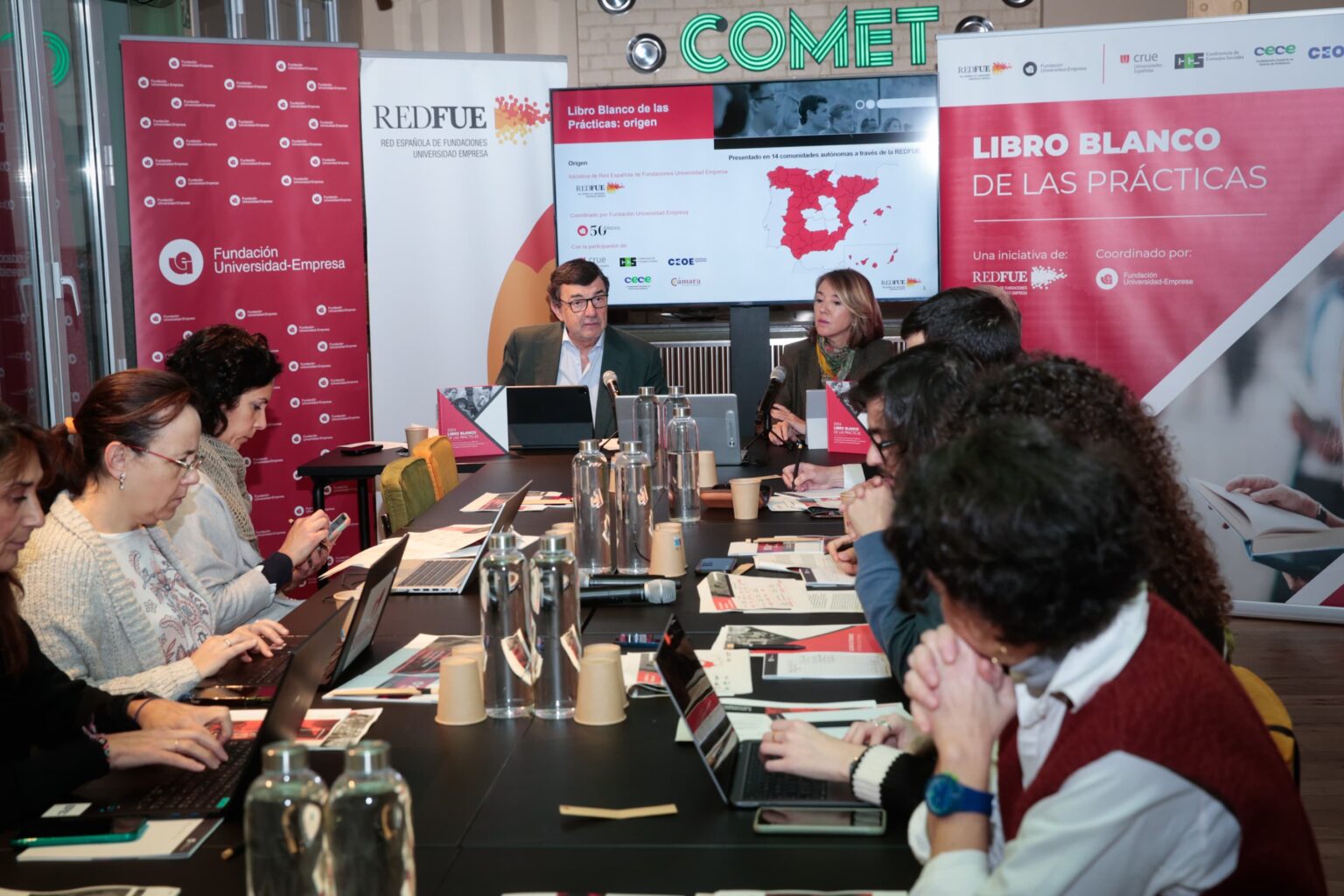
The Red de Fundaciones Universidad-Empresa (REDFUE) has presented the White Paper on Internships, the first guide on external academic internships in regulated university training and vocational training placements.
The aim of this initiative, promoted by REDFUE, is to provide guidance for the main agents involved: Public Administration, host companies and entities, managers, tutors and students, based on the consensus and participation of all of them, in view of the social debate raised by the draft bill on the “Statute for people in non-work practical training in the company environment”, colloquially known as the “Trainee Statute” promoted by the Ministry of Labour and Social Economy.
The White Paper on Internships is the result of choral and consensual work between six significant entities in the field of higher education and the business sector in Spain. Promoted by REDFUE, the CRUE (Conference of Rectors of Spanish Universities), the Conference of Social Councils of Spanish Universities (CCS), the CEOE, the Spanish Council of University Students (CEUNE), the Spanish Confederation of Education Centres (CECE), and the Spanish Chamber of Commerce have collaborated in its preparation. The work carried out for the preparation of the document has been coordinated by Carmen Palomino, Director General of the University-Business Foundation (FUE).
A necessary and comprehensive guide
The White Paper is a response to the widespread confusion about internships in Spain, where terms such as “academic training”, ‘training practices’ and “non-labour practices” are used interchangeably, often without recognising the legal and functional differences between them, and are confused with the concept of a grant, and therefore a scholarship holder. This lack of knowledge affects students, host entities and managers alike, making it difficult to apply current regulations correctly and to take advantage of the benefits offered by internships.
In this sense, the White Paper on Internships takes an exhaustive look at the evolution of the legislation regulating external academic internships and training placements in Spain since 1981 (12 royal decrees and 5 laws), always framed within the training and not the employment sphere. On an international level, it includes the analysis of the ‘Traineeships Under Youth Guarantee’ report of 2018, carried out by the European Commission.
In addition, the document clarifies basic concepts, delimits the coverage of external academic internships and placements, explains their typologies – those that are academic internships and those that are not – and provides a glossary of terms and summary and comparative tables, which shed light on the current confusion of terms. It also establishes criteria to help identify misuse, taking into account current legislation, and defines the necessary requirements for quality and productive placements for all those involved.
Employability impact and proven benefits
The White Paper highlights the key role of academic internships and traineeships in improving youth employability. According to recent studies by the Ministry of Education and the FUE, students who undertake internships increase by four points the possibility of finding their first job in less than six months and reduce by eight points the risk of unemployment four years after graduation. In Vocational Education and Training, internships are associated with even higher job placement rates, especially in the dual mode.
The document also shows that internships benefit not only students, but also companies and society at large. For participating organisations, internships facilitate access to young talent and serve to enhance their employer brand and foster internal innovation. On the other hand, educational institutions strengthen their link with the labour market through internships and update their curricular content and programme design to bring them in line with the reality of employment.
Proposals for continuous improvement and international projection
The White Paper also includes specific recommendations to optimise the internship system in Spain. Among them, it highlights the need to integrate internships as an essential part of the curriculum, to encourage the co-design of programmes with host entities, and to promote structured competence-based assessment.
It also stresses the importance of training and certification of both academic and business tutors, continuous student monitoring and the creation of digital ecosystems that connect educational institutions with host entities to facilitate all processes.
In order to guarantee the rights of interns and ensure that they obtain quality training experiences, the authors believe that clear limits must be established in agreements on the tasks that students can perform and ensure that they are focused on learning, as well as regulation and monitoring by education and labour authorities to ensure compliance with regulations.
With this publication, REDFUE reinforces its commitment to improving the training and employability of young people in Spain, promoting a model of academic internships that is aligned with the quality principles established by the European Commission.
The White Paper is not only a tool to address current challenges, but also a guide that aims to position Spain as a benchmark in external academic placements and training placements at international level.