
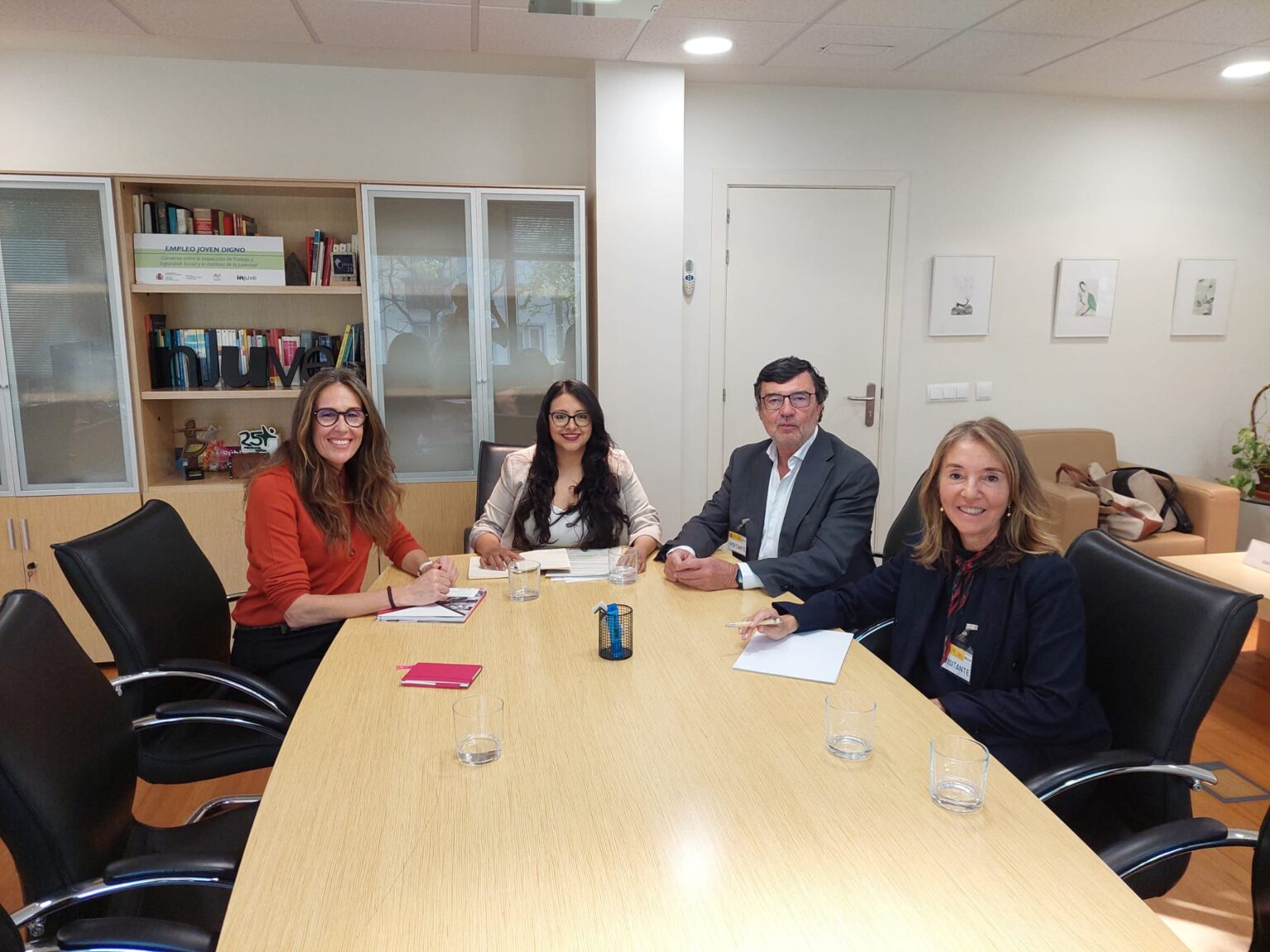
RedFUE and the Fundación Universidad-Empresa held an institutional meeting with the Director General of INJUVE, Margarita Guerrero Calderón, with the aim of analysing the current situation of young people in accessing the labour market and exploring new paths for public-private collaboration to enhance their employability.
During the meeting, held at INJUVE’s headquarters, the main lines of work of REDFUE and the Fundación Universidad-Empresa were presented, highlighting their track record in internship management, company-based mentoring models, and their work in academic and career guidance from early educational stages. Initiatives such as the “Youth Talent Driving Company Seal” and the micro-credential for company tutors were also introduced, aimed at strengthening the quality of training experiences in professional environments.
One of the central topics discussed was the anonymous complaints mailbox promoted by INJUVE in collaboration with the Labour Inspectorate, conceived as a tool to identify potential situations of vulnerability in young people’s initial work experiences. In this context, REDFUE emphasised the importance of complementing such instruments with pedagogical support, guidance, and active listening, offering its collaboration in analysing reported cases and improving support processes for students and company tutors.
The meeting also addressed structural challenges such as gender and generational biases, the underuse of training-based contractual modalities—such as dual training contracts and contracts for professional practice—as well as the need to bring public policies closer to young people through more accessible and understandable language.
For its part, INJUVE outlined its current strategic priorities, including the promotion of training in sectors aligned with territorial needs, in collaboration with SEPE and FUNDAE, as well as the development of micro-credentials aimed at rapid labour market integration and reducing situations of exclusion.
Both parties agreed on the need to move towards a more flexible transition-to-employment model, combining academic education with practical learning in companies and recognising the diversity of possible career pathways. In this regard, the key role of University-Business Foundations as intermediaries between the education system and the business sector was underlined.
The meeting concluded with a strong institutional alignment and a shared commitment to continue working together on initiatives that structurally improve youth employability. As a next step, a follow-up meeting is expected to take place in the coming weeks to define specific lines of collaboration.