
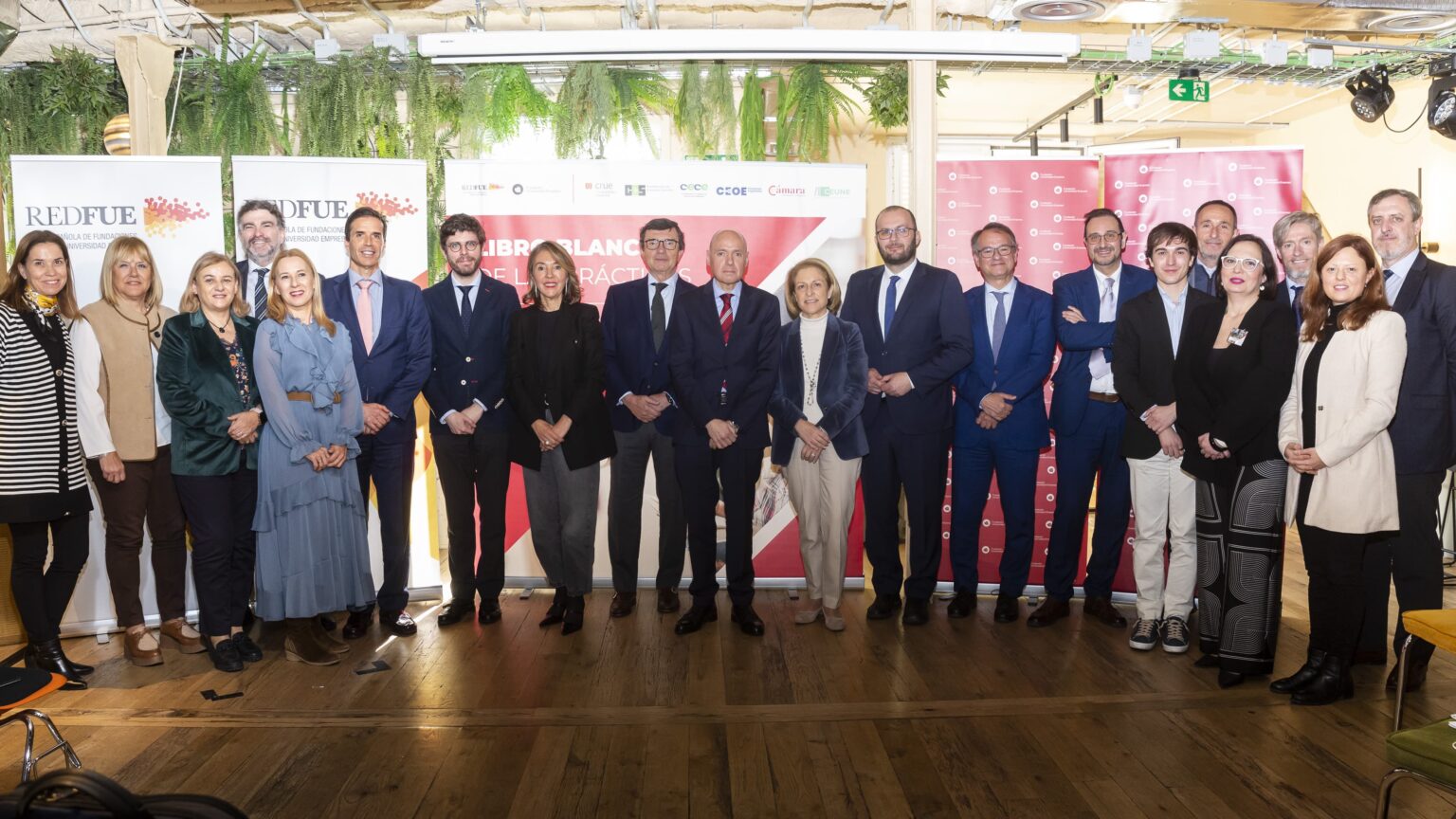
- The Secretary General of the Ministry of Universities highlights that ‘the internship system in Spain is a success story that has a consolidated legal basis that recognises its fully formative nature’.
- The Red de Fundaciones Universidad-Empresa (REDFUE) presents the White Paper on Internships to universities, training centres and companies in a joint effort to improve the employability of young people.
- The publication includes specific proposals to improve the internship system in Spain, such as integration into the curriculum, certification of tutors, improved regulation and the creation of digital ecosystems that facilitate the connection between students, companies and educational institutions, both university and vocational training.
La Red de Fundaciones Universidad-Empresa (REDFUE) has presented the White Paper on Internships to the main agents of the educational and business community. This pioneering guide, coordinated by FUE, aims to become an essential reference for the main agents involved: Public Administration, host companies and entities, managers, tutors and students, based on the consensus and participation of all of them, in view of the social debate raised by the draft bill on the “Statute for people in non-work practical training in the company environment”, colloquially known as the “Trainee Statute” promoted by the Ministry of Labour and Social Economy.
The White Paper on Internships is the result of a choral and consensual work between six significant entities within the field of higher education and the business sector in Spain, who attended the meeting yesterday. Promoted by REDFUE, the CRUE (Conference of Rectors of Spanish Universities), the Conference of Social Councils of Spanish Universities (CCS), the CEOE, the Council of University Students of the State (CEUNE), the Spanish Confederation of Education Centres (CECE), and the Spanish Chamber of Commerce have collaborated in its preparation.
The Secretary General for Universities of the Ministry of Science, Innovation and Universities, Francisco García Pascual, who closed the meeting, underlined the commitment of the university system to the continuous improvement of the practical training of students and stressed that ‘the internship system in Spain is a success story, and it is worth saying so clearly’. Since the start of the European Higher Education Area in 2007-2008, more than 4 million students have carried out internships in the country, consolidating this model as a key tool in their training. He also emphasised that the current legal framework guarantees the formative nature of academic internships and called for continued improvement of this system, listening to students and strengthening collaboration between public and private institutions to ensure the best preparation of university talent.
For her part, the Vice-counsellor for Universities, Research and Science of the Regional Government of Madrid, Ana Ramírez, highlighted the importance of the in-depth reflection that the White Paper on Internships represents, and congratulated REDFUE for this initiative that ‘has built bridges between universities and companies’. Ramírez stressed the importance of protecting the links between university and business and of continuing to promote dual university training that guarantees quality and specialised preparation for students.
Fernando Martínez, president of REDFUE, highlighted the fundamental role of collaboration between all the actors participating in the consolidation of a quality internship model. ‘This guide strengthens cooperation and responsibility among all the actors involved and ensures that internships are educational, are aligned with the needs of the labour market and, above all, are quality internships’.
During her speech, Carmen Palomino, General Director of FUE, summarised the content of the White Paper on Internships, which clarifies basic concepts, delimits the coverage of external academic internships and placements and includes all existing legislation since 1981. In addition, the document explains their typologies – those that are academic placements and those that are not – providing a glossary of terms and summary and comparative tables that shed light on the current confusion of concepts. It also establishes the criteria that help to identify misuse, taking into account current legislation, and defines the necessary requirements for quality and productive practices for all parties involved.
At the round table ‘The commitment to quality internships’, experts from different fields discussed the challenges and opportunities of training in the workplace. Moderated by Carmen Palomino, the round table was attended by Rosa Visiedo, Vice-President of CRUE and Rector of the San Pablo-CEU University; Miguel Ángel Acosta, Secretary General of the Conference of Social Councils of Spanish Universities (CCS), Santiago García, Secretary General of the Spanish Confederation of Education Centres (CECE), Diego Gibanel Faro, Vice-President of the CRUE and Rector of the San Pablo-CEU University (CECE); Diego Gibanel Faro, Deputy Secretary of the Spanish Council of University Students (CEUNE); César de la Fuente, Head of the Education and Training Department of CEOE and David Navarro, Deputy Director of Training, Employment and Entrepreneurship of the Spanish Chamber of Commerce. During the debate, different issues were addressed, such as the need for a stable regulatory framework, the recognition of the role of tutors and the adaptation of internship programmes to the real needs of the business system.
The presentation concluded with a panel of success stories, where different actors in the internship ecosystem shared their experiences and best practices. Moderated by Montse de Pablo, FUE’s Expansion and Development Manager, the session included the testimonies of Yolanda Montoro, Deputy Director of the Internship Department at ADEIT; Teresa Romero, Head of Executive and Internal Communication at IBM Europe, Middle East and Africa and company tutor; Camila Cuetos, External Relations specialist at IBM SPGI and former internship student at IBM; and Silvia Robador, Director of the Nebrija Institute of Vocational Training. The participants highlighted the positive impact of internships on the labour market insertion of young people and the need to establish synergies between companies and educational centres to guarantee an enriching training experience that is aligned with the labour market.