
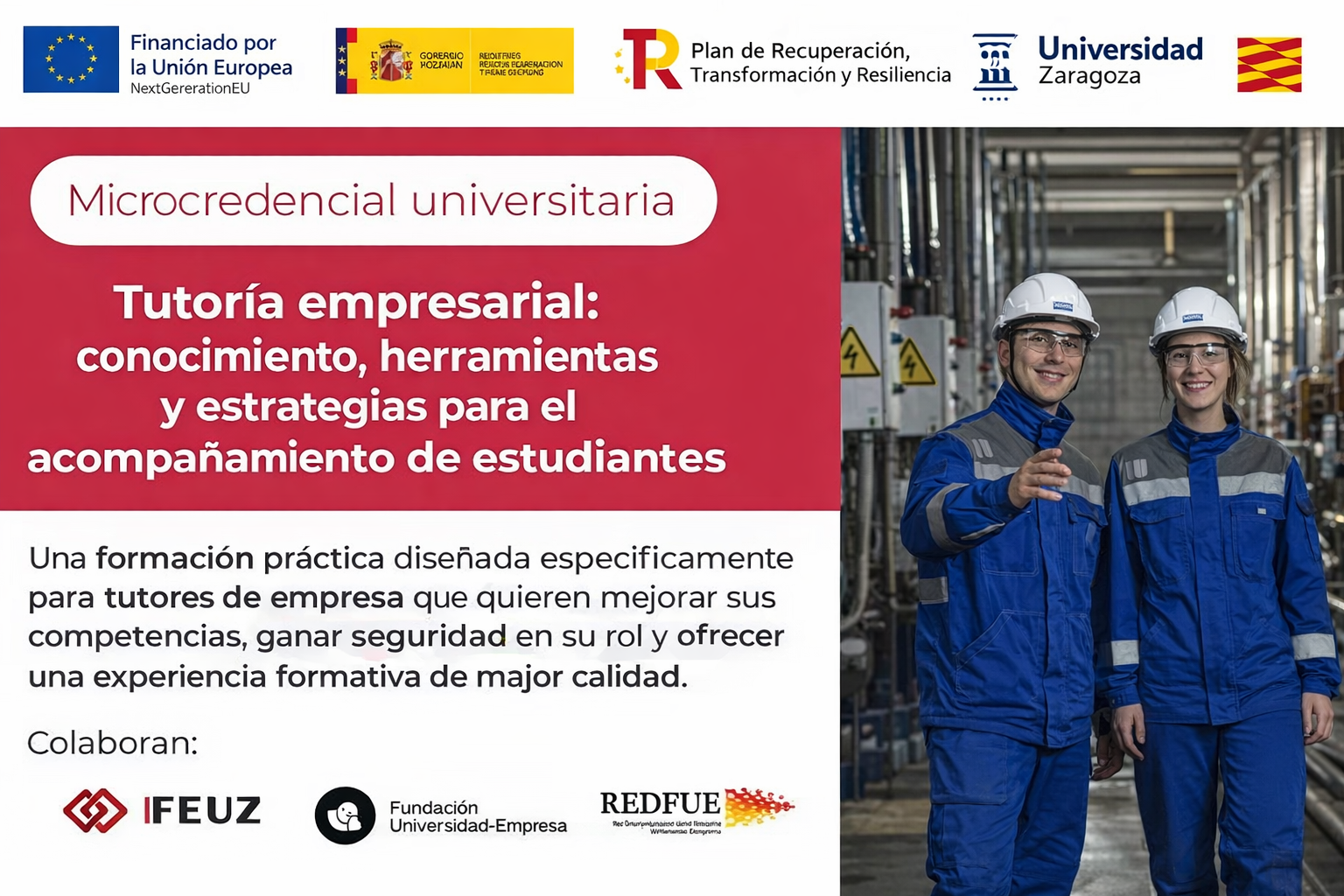
- The new university micro-credential, developed by the University of Zaragoza, draws on the FUE’s extensive experience in training tutors and has been promoted by the FUE, RedFUE, the University of Zaragoza Business Foundation (FEUZ) and the University of Zaragoza.
- The 75-hour programme, accredited with 3 ECTS credits, aims to professionalise the support provided to students on work placements and to enhance the quality of training experiences within companies.
- All students have completed the programme and rated it with an average score of 4.55 out of 5.
The first 25 business tutors trained at the University through the University of Zaragoza’s new university micro-credential “Business Tutoring: knowledge, tools and strategies for supporting students”, have now obtained their certification after successfully completing this specialised programme, promoted by the University-Business Foundation (FUE), the University of Zaragoza Business Foundation (FEUZ) and REDFUE to professionalise the support provided to students on work placements within companies.
The 75-hour course, accredited with 3 ECTS credits, was delivered nationwide by the University of Zaragoza and the University of Zaragoza Business Foundation (FEUZ), achieving a 100% completion rate and an average rating of 4.55 out of 5 from participants.
In Spain, practical training in workplace settings—through work placements or internships in both higher education and vocational training—has established itself as an essential element for entering the labour market and developing professional skills, enabling more than 1.1 million people a year to gain real-world experience in companies. For these placements to be effective and retain their educational value, they must have a structured training plan and continuous support from academic and business mentors, whose work is crucial to the quality of learning, the acquisition of skills and the student’s adaptation to real-world work environments.
At REDFUE, we believe that “microcredentials represent a key shift in training: more flexible, more agile and directly linked to the real needs of businesses. Initiatives such as this training for tutors reinforce an essential element that is often overlooked: the quality of work placements depends largely on those who support the student throughout the process”.
Furthermore, we maintain that “universities and businesses are part of the same ecosystem. If we want young talent to be truly prepared, we need not only more opportunities, but better training experiences. And that involves professionalising and recognising the role of the tutor, both academic and corporate”.
Throughout the training, participants have explored aspects such as the regulatory framework for work placements, the student profile, the design of training experiences within the company, and the implementation of monitoring, support and assessment strategies. The programme has been structured into five theoretical and practical modules and has been designed with a practical focus, developed ‘by tutors, for tutors’.
“With this micro-credential, the University-Business Foundations are taking a further step in their commitment to the quality of work placements. It is not just about students gaining professional experience, but ensuring that this experience is well-designed, supported and geared towards the actual development of skills.”
A programme with a high level of commitment and excellent feedback
The training has enabled the first 25 business mentors to be certified; they have already obtained their university degree with European accreditation after successfully completing the programme. The micro-credential has recorded a 100% completion rate, with average marks close to 10, reflecting the high level of commitment from the students and the suitability of a flexible format designed for working professionals.
The programme has also received an average rating of 4.55 out of 5 in the surveys conducted at the end of the training. Participants who trained from 3 March to 9 April particularly highlighted the practical applicability of the content, the quality, the practical value of the skills acquired and the opportunity to apply what they have learnt in their workplace.
Furthermore, mentoring also generates value for those who undertake it: according to data from FUE, 70% of mentors state that their experience as a mentor improves their skills in leadership, communication or people management, and 55% acknowledge that it helps them stay up to date and incorporate new tools and approaches into their day-to-day work.